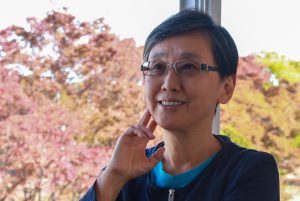
 Professor Haeng-ja Chung is a cultural anthropologist who teaches “Japan and Beyond” module, including Feminist Ethnic Studies.
What is this module about?
Taught by Professor Haeng-ja Chung, a cultural anthropologist and scholar of feminist ethnic studies, the Japan and Beyond module offers the fundamentals to overcome intersectional discrimination—a form of unfair treatment that occurs when multiple characteristics, such as race, gender, and class interact simultaneously to cause compounded experiences of oppression. This learning is indispensable for GDP—a community comprised of diverse people. Surprisingly, many people are unaware of their own racial and gender biases, and students aspiring to join GDP are no exception. Recognizing and removing one’s own prejudices is painful, but it is essential as a GDP member. Sample courses include Feminist Ethnic Studies, Korean Diaspora, Topics in Japan and Beyond I & II, Cultural Anthropology, Colonialism and War, Sex Work and Emotional Labor. Each course provides three credits over two terms and may include online components and/or field trips, which require punctuality, responsibility, and self-discipline. The module encourages students to investigate the complexities and contradictions of power relations among individuals, communities, and states. It critically explore cultural dynamics through an anthropological lens. Familiar concepts take on new meanings in intercultural contexts, and students are invited to reexamine their assumptions through comparative analysis and self-reflexivity—such as exploring one’s own positionality, identity, and biases. For instance, what is often referred to as “Japanese culture” is neither singular nor static—it is contested, evolving, and deeply contextual.
What do you want students to get out of this module through taking your courses?
I want students to connect their academic learning with their everyday lives and lived experiences. This module encourages them to become self-motivated, open-minded learners who actively explore Japan and beyond—not only through coursework but also through meaningful engagement with both local and natal communities. By comparing and contrasting these experiences, students can deepen their understanding of diversity and the complexities that exist both between and within communities. Most importantly, I hope they cultivate the ability to reflect critically on themselves—their assumptions, positionality, and biases—in order to grow as thoughtful, glocally aware individuals.
What is the most important thing about university education for you?
For me, the most important aspect of university education is fostering self-discovery and self-reflexivity. It is a time for students to question who they are, what they believe, and how they relate to the world around them. I value the integration of theory and practice—learning not only through texts and classrooms but also through real-world engagement and meaningful action. University should cultivate self-motivated learners who actively seek knowledge and connect with people from diverse backgrounds. Just as importantly, it is a critical period for establishing a sense of responsibility and consideration as an adult—becoming aware of one’s impact on others and contributing to communities with empathy, integrity, and self-reflexivity.
What kind of topics can students in your research seminar do for Senior Project?
Students in my research seminar are encouraged to explore topics they are passionate about. Possible areas include DEIA (Diversity, Equity, Inclusion, and Accessibility), feminist ethnic studies, and critical examinations of racism, sexism, and the intersectionality. Whether explicit or implicit, self-reflexivity is mandatory. In addition, students may choose formats, such as creative writing and autoethnography. Other examples include critical analyses of university entrance exams, club activities, or financial topics like investment. I support interdisciplinary and innovative approaches as long as they are approached through an anthropologically conscious lens. I encourage students to develop projects that meaningfully connect theory and practice (lived experiences).