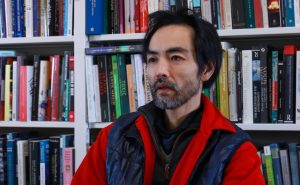
Professor Tak Uesugi is an anthropologist who teaches “Environment and Health” module.
What is this module about?
People often say that anthropology is a “study of culture.” It’s not wrong, but it doesn’t completely capture what it is really about. Anthropologists nowadays often say that anthropology is ultimately about exploration of alternative possibilities. Traditionally, anthropologists tended to go faraway from home to learn about worldviews and practices very different from their own. Nowadays, anthropologists also look somewhere closer to home: it can be the marginalized experiences of people within our own society, or it can be the new (sub-) cultures emerging in relation to new technologies, or it can even be the lives of non-human creatures who constitute the environment in which we cohabit. By exploring these diverse life ways, we attempt to gain imaginative and practical capacity to challenge our own ways of thinking and relating to our worlds.
What do you want students to get out of this module through taking your courses?
I believe that the most important lesson of anthropology is that there are always other possibilities. (It’s not limited to the youth to feel suffocated by their society; older people do too!). By engaging with unfamiliar cultures (people and their stories, practices, etc.), I hope, students gain critical capacity to question their own commonsense “reality” and start imagining alternative futures.
In addition, of course, I also want students to develop academic skills, such as the ability to read complex writings, think critically from multiple perspectives, and ultimately come up with their own “voice”, so to speak. Especially in this age of generative AI, which tends to homogenize users’ styles of thinking and writing, developing one’s own “voice” may be a form of resistance to assimilation.
What is the most important thing about university education for you?
Maybe… learning to doubt? It can be the information thrown at you online or offline, or “commonsense” instilled into you since your childhood. Questioning them is the first step to becoming a free and critical thinker. But then, you don’t want to stop there. You’d also want to formulate your own thoughts by connecting those doubts to historical, sociocultural, and political contexts—as well as theoretical concepts. And this process takes some diligence and creativity. University offers a unique environment that allows you to contemplate on worldly issues in conversation with other people, including your peers, professors, and published materials.
What kind of topics can students in your research seminar do for Senior Project?
I’ve had students working on Senior Projects on a wide range of topics and formats. Some students have even worked on creative projects like “anthropological” short stories and fantasy novel writing. Some students conducted ethnographic studies, for example, ones based on fieldwork with environmental activists and developers in the Philippines, middle-aged women experiencing menopause and their physicians in Japan, sex education and adolescent girls’ empowerment workshops in South Africa, online game players, and so on. We’ve also had several interview-based studies on medical disorders and elderly care, or relationship between anime characters and historical consciousness.
Course list:
Culture and Illness, Anthropology of Food, Anthropology of Disaster, Environmental Anthropology, Medical Anthropology, Anthropology of Science, Anthropology of Memory, Anthropology of the Self, Ethnographies in Medical Anthropology, Seminar in Medical Anthropology