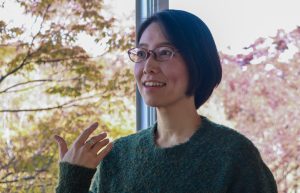
Professor Haruna Miyagawa is a sociologist who teaches “Migration and Communities” module.
What is this module about?
World today is characterized by an increasing number of people moving across international borders. Why? Why do people move? What draws them to a particular place? What happens to their home country when they move? How does their relationship with home change? How do they make home in a foreign land, and remember their “homeland” across multiple generations?
The courses in this module explore these questions by looking at how historical and contemporary relations – international and domestic – affect migration experiences. We read seminal works in migration studies, postcolonial theories, and even fictional writings to reflect on the social forces at play in migrants’ lives, and imagine what it’s like to be crossing “borders” of many sorts and living in a complex, transnational world. I hope students gain critical ability to question the categories and assumptions that often drive divisive public debates around migration and other global issues such as development and tourism.
What do you want students to get out of this module through taking your courses?
I would say, a joy of learning and a habit of engaging the world by closely interacting with the sources – readings, people, events, etc. Learning becomes all the more interesting when these interactions become multidimensional!
Through patient analyses and in-depth discussions based on careful reading, I encourage my students to be conscientious citizens who make informed, thoughtful decisions based on comprehensive understandings. Rather than relying on easily accessible and partial information, or uncritically accepting dominant narratives, as students of sociology, I would like my students to be able to examine the evidence by paying attention to the credibility of the sources and genealogy of ideas, as well as connecting dots that may seem unconnected. I hope this arduous yet creative process nurtures humility toward reality, which can then broaden their perspectives toward everyday life.
What is the most important thing about university education for you?
Perhaps to tangibly gain the ability to trust that the world is much larger than you think, and yet one’s presence matters to the world – in big and small ways. I believe university education exists with this very promise: Rejuvenating hope. University offers 1) enormous opportunities to meet and dialogue with all kinds of people – both alive and passed (via their works), near and far, 2) various tools that allow you to interrogate what you have considered as “the givens” of life, 3) time and space to test the limits and discover potentials in yourself and in communities, etc. Moreover, the collegial academic environment and scientific endeavor of the university offer a fertile ground for cultivating communal responsibility and integrity, which is the very fabric of our civic life.
What kind of topics can students in your research seminar do for Senior Project?
Students’ interests vary quite a bit in my research seminar but many explore topics related to the following: identity and sense of belonging, education, urban development and subculture, and inter-generational relationships. The medium of Senior Project is decided by each student in conversation with the faculty. It has ranged from academic research paper, creative writing, compilation of interview-based essays, documentary film, and photo exhibition with ethnographic vignettes or qualitative research.
Course list:
Sociological Imagination, Global Sociology, Sociology of Migration I/II, Logic and Methods of Social Inquiry, History of Social Thought, Urban Sociology, Globalization and Development, Gender in Global Context